

Over the past twelve months the Curium platform grew substantially: a full compliance audit suite, AI capability running through every module, an open integration layer, and a great deal of everyday usability work. Delivery capacity roughly doubled without adding to the engineering team.
The question that matters is what clients get from that. This article covers what was built, what changed in day-to-day use, and how we increased speed while making the platform more reliable rather than less.
What clients get from faster delivery
Speed is not a benefit in itself. It is what produces the benefits.
Requests turn around in hours or days
This is the change clients notice first. When delivery capacity doubles, the queue stops being the constraint.
A field added to a form, a report cut differently, a change to how an obligation maps to a product line — these move from roadmap conversations to work completed this week. For a compliance platform that matters more than it would elsewhere, because client requests are usually driven by a regulatory deadline rather than a preference.
Fewer issues reach you
Twelve months ago the platform had very little automated testing. Today every change runs against thousands of automated checks before it can merge, and the product is exercised end-to-end against staging every night.
The practical effect is that problems are increasingly found by us rather than reported by a client. That is the whole point of the investment.
The platform reflects regulatory change quickly
Codes are rewritten, guidance is reissued, expectations shift. A platform that takes months to absorb a regulatory change leaves its clients behind it. Faster delivery is what keeps the product current with the environment our clients are actually operating in.
What was built this year
Compliance audit suite
The largest single area of work, built from the ground up. Versioned audit templates, structured evidence collection, and an automated audit engine whose reasoning can be inspected step by step rather than taken on trust — alongside attestations and registers.
This is the capability that moves file review from a sample of thirty to something that can run across a population.
AI across the platform
An in-app assistant that takes real actions rather than only answering questions. An AI decision engine for claims assessments. Document reading and data extraction. AI triage of incoming complaints. Product disclosure statement comparison. Website compliance scanning. Semantic search.
The theme through all of it is the same: moving Curium from a system that records what people enter towards one that reads, reasons and surfaces things on its own.
Claims
A decision engine for assessments, a fleet portal with quote authorisation, vehicle assessment integration, richer claim financials, and automated lifecycle milestones so files progress without manual chasing.
Complaints and incidents
Workflow and handling upgrades across both modules, partner assignment through the Service API, and AI triage of incoming complaints so they are classified and routed on arrival.
Integrations and the open platform
A Service API with managed tokens so partner systems can connect securely. Webhooks with their own test harness. Email link tracking. And an MCP server, which allows AI assistants such as Claude to work with Curium directly — so a compliance manager can ask questions of their own data in plain language.
Everyday usability
No single item here is dramatic, and collectively they matter as much as anything above.
Instant record search from anywhere in the product. Saved table views, so nobody rebuilds the same filter every morning. A single shared bulk import replacing eight different implementations across admin tools. A rebuilt form builder.
These determine whether the platform is pleasant to use for six hours a day, which is a separate question from whether it is capable.
Want to see how these capabilities work in practice? Explore the Curium platform and see how we’re helping insurance teams manage risk and compliance with greater confidence: AI-Powered Insurance Compliance & Claims Software | Curium
Does moving faster make the platform riskier?
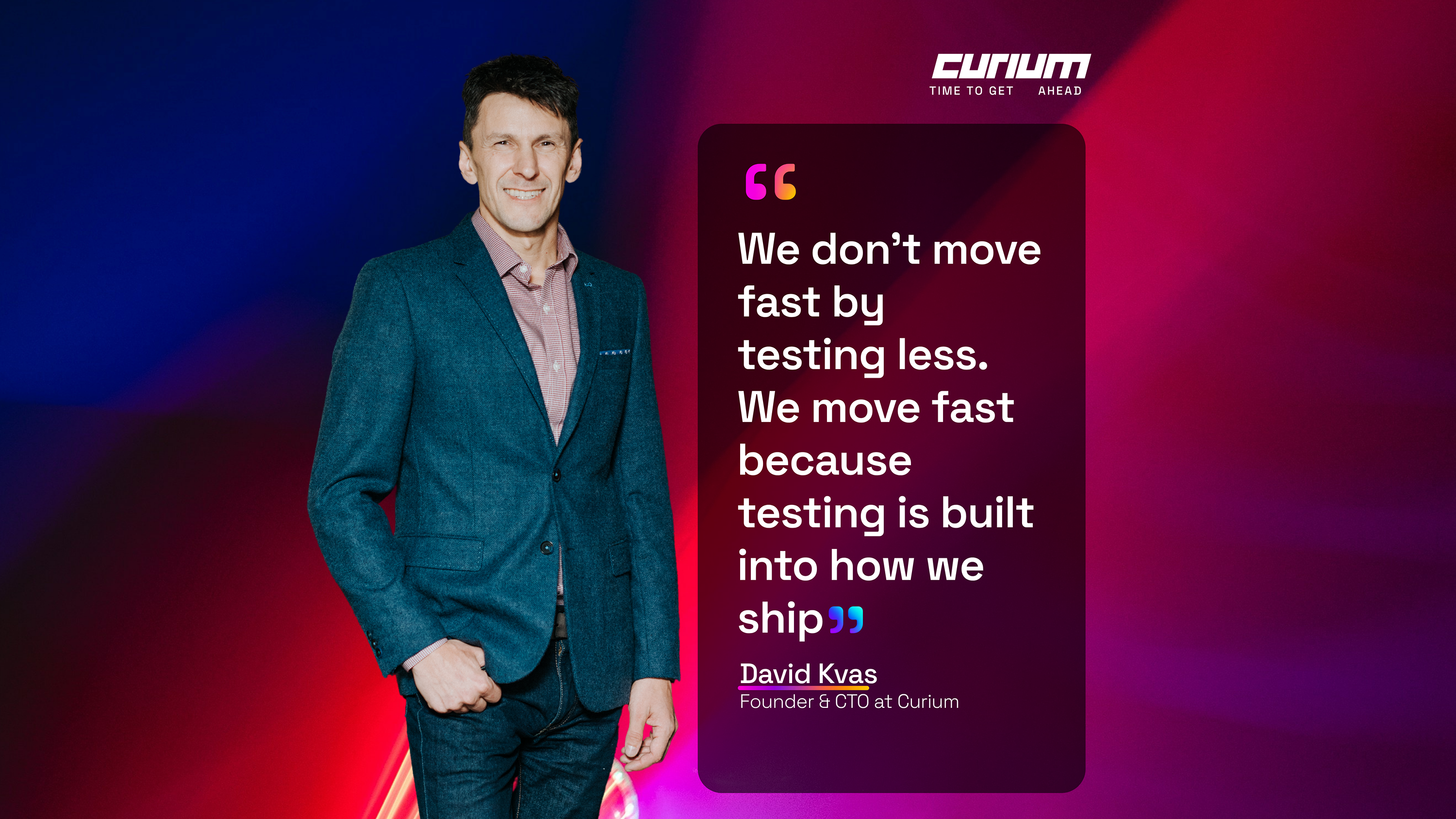
It is the right question to ask any vendor claiming a large increase in delivery speed. The answer is that we don’t move fast by testing less. We move fast because testing is built into how we ship.
Four mechanisms.
Every change is gated. All work lands through reviewed pull requests with automated quality gates — type safety, security checks and the full test suite. Nothing merges without passing.
Features ship dark. New user-facing features are released behind flags, switched off by default, and enabled per client when that client is ready. Deployment and release are separate events, so the product can be updated continuously without any client’s environment changing beneath them.
Changes move through staged environments. Development, then staging, then production, with nightly end-to-end checks that exercise real workflows the way a user would, and monitoring throughout. Most regressions are caught there rather than in production.
AI-assisted work passes the same gates. A meaningful share of our code changes are now authored by AI agents working under engineer supervision. There is no separate track: agent changes go through identical review and identical testing, with a named engineer accountable for every merge. The gain comes from agents operating inside a system already built to catch mistakes — which is why the testing infrastructure came first.
Why this matters for a compliance platform
If an insurer relies on a system to detect breaches, hold obligations and evidence controls, that system’s reliability becomes part of the client’s own control environment. Software dependability is not an internal engineering concern in that situation.
It is also the same argument we make to clients about their controls. An attestation that something works is not evidence that it works. We hold ourselves to that standard, and the testing regime is how.
Want to see how Curium could work within your own risk and compliance environment? Book a demo with our team and explore the platform in action.
Frequently asked questions
What did Curium build this year? A full compliance audit suite with versioned templates, evidence collection and an inspectable automated audit engine; AI capability across the platform including a claims decision engine, document data extraction and complaint triage; claims and complaints module upgrades; an integration layer with a Service API, webhooks and an MCP server; and substantial usability improvements including instant search, saved views and a rebuilt form builder.
How does Curium prevent faster releases from causing problems? Automated quality gates on every change, feature flags so new functionality ships disabled and is enabled per client, staged promotion through development and staging to production, and nightly end-to-end testing against staging with continuous monitoring.
Is AI-generated code reviewed before reaching production? Yes. AI agents work under engineer supervision, and their changes pass the same automated testing, security checks and human review as any other change, with a named engineer accountable for each merge.
What are feature flags and why do they matter for insurance software? A feature flag lets code be deployed to production while the feature stays switched off, separating deployment from release. Software can be updated continuously while each client’s environment changes only when that client is ready — which matters when the software supports regulated processes.
Can Curium connect to other systems? Yes. A Service API with managed tokens allows partner systems to connect securely, webhooks push events outward, and an MCP server allows AI assistants to work with Curium data directly.
How quickly can Curium reflect a regulatory change? Faster delivery capacity means changes driven by regulatory deadlines are typically handled in days rather than release cycles, rather than waiting for a scheduled release.
Author:
David Kvas, Founder & CTO at Curium. LinkedIn Profile.