

Every system requires some level of learning. Even an iPhone does. But the difference is how much effort that learning takes, and where it sits.
With most insurance platforms, the burden is on people. They are trained on screens, workflows, and steps. They are expected to remember where things sit and how processes fit together. Over time, they become “good at the system”.
With well-designed products, the burden shifts. People still learn—but they learn the logic of the task, not the mechanics of the tool. The system aligns with how they naturally read, decide, and act.
Why training-heavy systems persist
Insurance software is often described as complex because the domain is complex. Regulation, products, and processes do add layers.
But that does not fully explain why:
- basic actions require multiple steps
- people rely on memory rather than guidance
- training becomes a continuous requirement
Many systems are designed from the inside out. They reflect internal processes, compliance structures, and organisational logic. People are expected to navigate that structure.
In reality, that’s not how work happens.
People scan, they prioritise, they get interrupted, and they rely on context. When systems don’t align with this, they compensate—through shortcuts, emails, and workarounds. That’s where inconsistency and risk begin.
What product teams usually miss
The most important design inputs are rarely captured in requirement documents.
People can tell you what they want. They are less able to tell you:
- where they hesitate
- what they routinely overlook
- what they think they’re doing vs what actually happens
- why they made a decision a certain way
These are not conscious.
They only become visible through proximity to real work—watching how a claims handler navigates a file, where a compliance manager pauses, what gets ignored under time pressure.
How Curium approaches this
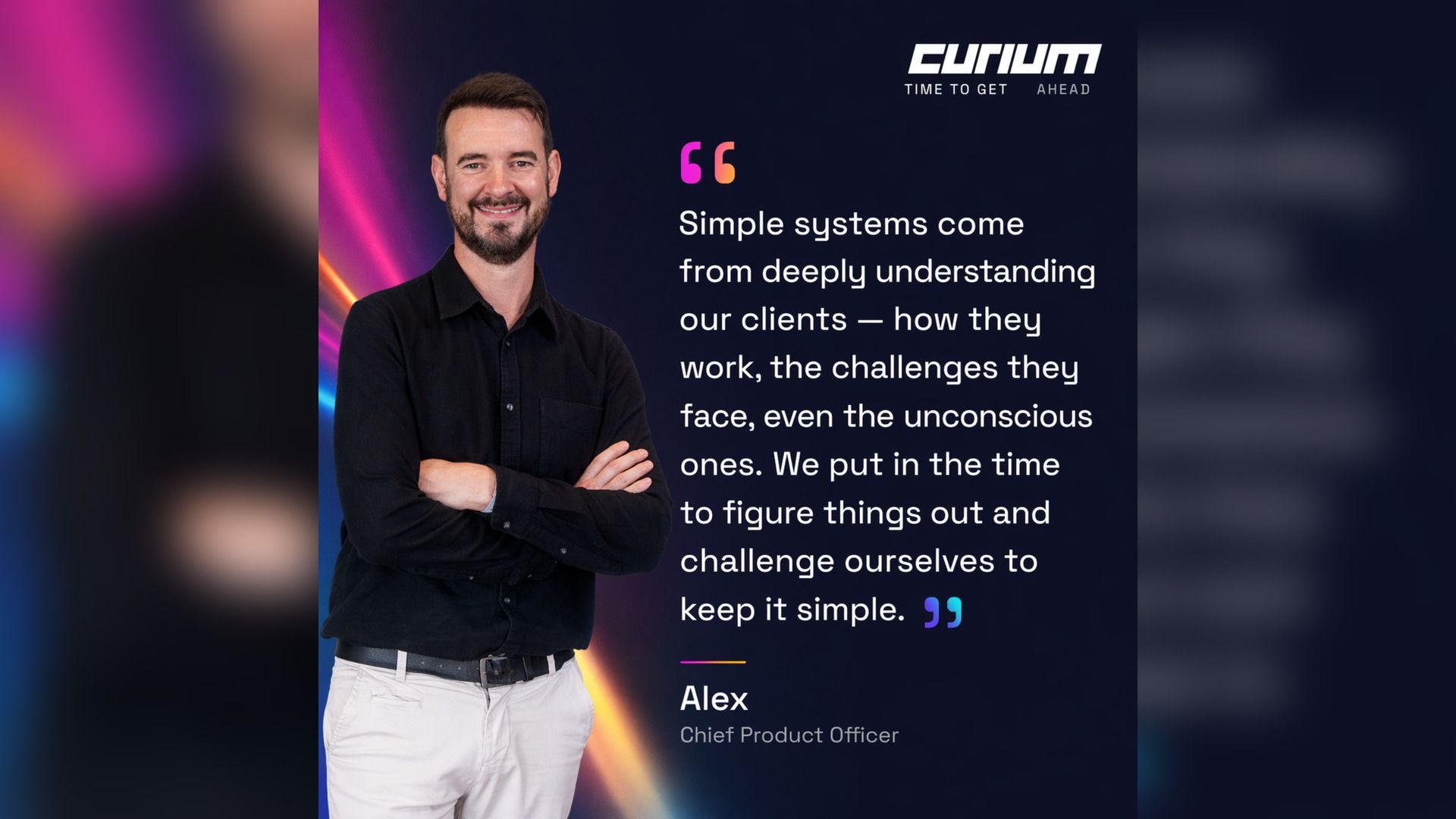
At Curium, product design is grounded in spending time with clients and understanding how work actually happens.
A lot of that comes down to how Alex Simpson and the team operate day-to-day:
- sitting with people rather than relying on requirements
- observing behaviour rather than collecting opinions
- digging into why things go wrong, not just what went wrong
- paying attention to small, repeated friction points
The focus is not on documenting the process.
It is on understanding the behaviour underneath the process — where people hesitate, where they improvise, and where blind spots sit.
Designing for behaviour, not process
When systems are shaped around behaviour, a few things change.
Information appears when it is needed, not where it “belongs”. Decisions are guided in context, rather than requiring people to recall rules. Steps reduce—not by removing capability, but by removing friction.
The system supports how people think, instead of forcing them to adapt.
What this looks like in practice
Curium onboarding typically takes less than an hour.
That time is not spent explaining the system. It is spent aligning on how to think about compliance—how to assess incidents, how to interpret obligations, how to make decisions.
The system itself requires minimal explanation because it reflects how people already work.
Final thought
The question is not whether people need to learn.
They always will.
The question is what they need to learn:
- the system or
- the job
Most insurance software teaches the system.
Curium is designed so people can focus on the job.
Author:
Tetiana George, CEO of Curium, Co-Chair of Insurtech Australia and member of ASIC Digital Finance Advisory Committee. LinkedIn Profile.