

The latest Curium Academy webinar opened with a quick poll. 77% of attendees said they have a compliance sign-off process for their marketing materials — and, tellingly, 19% had no idea whether one exists at all. Then came the follow-up: how well does that process work? Only 16% called it effective with same-day approval. A third said it’s not effective and delays their marketing releases, and just over half live with a one-to-two-day lag on every piece of content.
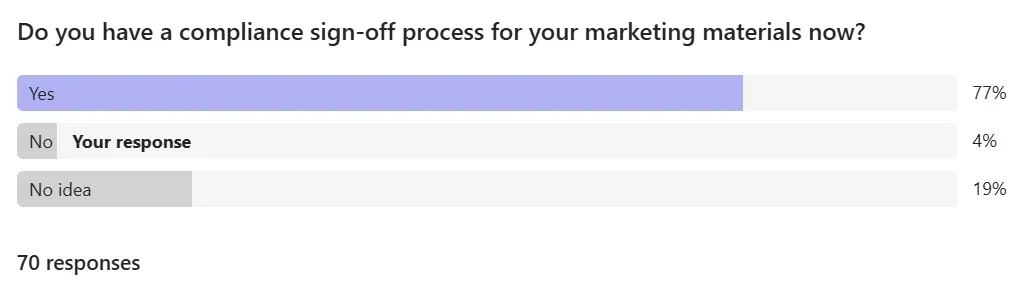
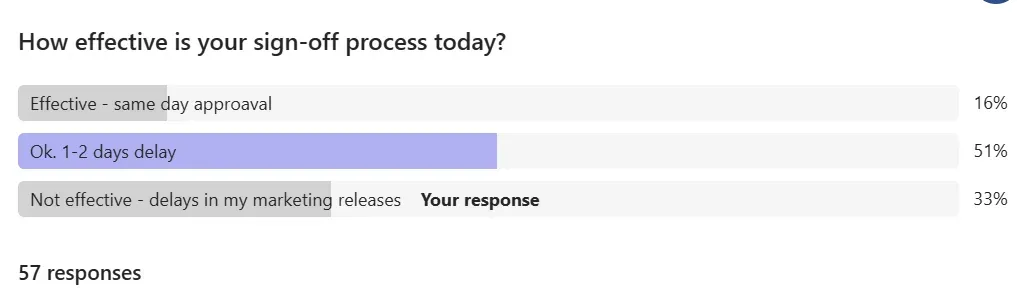
Live polls from the webinar: most firms have a sign-off process — very few trust it.
That gap — everyone has a process, almost nobody trusts it — is exactly why ASIC’s timing matters. On 9 June 2026, ASIC released its first update to Regulatory Guide 234 (Advertising financial products and services) since 2012. Fourteen years of new media, new enforcement actions and now AI, all folded into one revised guide.
Tetiana George (Curium) was joined by Yvonne Lam, partner at Clyde & Co, and Mikaela Eldridge, senior associate and formerly of ASIC’s enforcement team. Here’s what the session covered — and what to do about it.
First, back to the law: what is misleading and deceptive conduct?
Yvonne’s opening point deserves repeating: don’t start with the regulatory guide, start with the law. RG 234 doesn’t create new obligations — the prohibition on misleading and deceptive conduct already sits across three pieces of legislation:
- Corporations Act 2001, s 1041H — conduct in relation to a financial product or financial service that is misleading or deceptive, or likely to mislead or deceive (supported by s 1041E on false statements and s 1041G on dishonest conduct)
- ASIC Act 2001, s 12DA — the same prohibition for financial services in trade or commerce, backed by s 12DB (false or misleading representations — ASIC’s favourite) and s 12DF (misleading conduct about the nature, characteristics or suitability of financial services)
- Competition and Consumer Act 2010, ACL s 18 — the general prohibition covering everything else
The practical distinction: the first two catch your regulated activity — advertising your products, your claims handling, your dealing and distribution. The Australian Consumer Law catches the rest. A business that also offers something that isn’t a financial service — claims recovery, supply chain services — and oversells it will find s 18 waiting. Different conduct, different regulator (ACCC rather than ASIC), same underlying rule.
A few principles from decades of case law worth keeping on a sticky note:
- The test is objective: would an ordinary, reasonable member of the audience be led into error?
- Intent doesn’t matter. Nobody needs to have suffered loss. Nobody even needs to have actually been misled — the likelihood is enough.
- Silence can mislead. Omitting a key exclusion can make a factually correct statement deceptive.
- And the one that catches people out repeatedly: a misleading impression can’t be cured by fine print or a link to an accurate PDS. If the headline creates the wrong impression, the disclosure document doesn’t save you.
The enforcement backdrop: RACQ and Choosi
This isn’t theoretical. Misleading pricing and advertising practices are a stated ASIC enforcement priority for 2026, and the insurance sector has provided both current test cases.
RACQ — ASIC commenced Federal Court proceedings in September 2025, alleging that between 2019 and 2024 RACQ sent over 570,000 renewal documents showing a “last period premium” that was often higher than what the customer had actually paid. One example: a renewal showing a move from roughly $6,900 to $7,000 — an apparent 1.5% increase — when the customer had actually paid around $5,000, making the real increase about 40%. The alleged breach is s 12DB of the ASIC Act. The matter is before the courts.
Choosi — proceedings commenced June 2025 under ss 12DB and 12DF. ASIC alleges the comparison site claimed to compare products from a range of insurers while, from July 2019 onwards, only comparing policies issued by a single insurer (with one limited exception), all distributed by an associated company. Over 4,000 funeral policies and roughly 9,500 life policies sold; $61 million in commissions received. Trial ran in May 2026; judgment pending.
Mikaela’s perspective from her ASIC days was useful here: outcomes scale with seriousness. An obscure overstated claim on a website might get resolved with a phone call. Systemic misrepresentation gets compulsory notices, compulsory interviews, civil penalty proceedings and licence conditions. The enforcement toolkit is broad, and so are the provisions it rests on.
What actually changed in RG 234?
Honestly — the principles haven’t. ASIC has said as much. What the June 2026 update does is modernise 14 years of context: new media, new technology, recent enforcement, and the design and distribution obligations that didn’t exist in 2012.
The most important addition is an overarching test: the overall impression created by the advertisement when a consumer views it for the first time. Consumers aren’t expected to watch your reel twice or re-read your banner. One viewing, one impression — is it accurate? Mikaela’s advice: use this as the final review question, because it’s almost certainly the question ASIC asks before deciding whether to dig further.
The ten content principles carry over largely unchanged — balanced messaging on benefits and risks, warnings with equal prominence to headline claims, realistic fees and costs, like-for-like comparisons only, past performance warnings, plain language over jargon, consistency with disclosure documents, and images that don’t undermine any of the above. Greenwashing gets an explicit mention under the balance principle: don’t claim green, carbon neutral or ethical unless you can substantiate it. (ASIC also felt the need to say that advertisers should stop using ASIC’s own logo to imply endorsement. Apparently that needed saying.)
RG 234 makes consistent review and clear evidence more important across every advertising channel. Curium helps insurance teams centralise regulatory obligations, controls and approval workflows in one place. Explore the Curium Compliance Platform.
Target audience and DDO — where the risk doubles
The updated guide explicitly connects advertising to the design and distribution obligations. Advertising must be consistent with the product’s Target Market Determination, and promoters must be able to demonstrate reasonable steps to direct advertising at that target market.
The subtle trap: the obligation extends beyond your target audience to your actual audience — everyone who might reasonably see the ad. A complex or high-risk product advertised where retail consumers will encounter it must still be simple enough for that actual audience to understand the risks. Get it wrong and the exposure doubles: misleading conduct and a DDO contravention.
New media, same rules
The second half of the guide covers how and where you advertise, and the message is blunt: the medium is never an excuse. A six-second reel, a billboard glimpsed at 80km/h, a paid search snippet — if the format can’t carry a balanced message for your product, the answer is not to trim the warnings. It’s to pick a different format.
RG 234 now names the formats directly: paid search results, in-app placements, push notifications, pop-ups, embedded and sponsored content. For social media specifically: warnings need equal prominence to headline claims, click-through links and QR codes don’t cure a misleading impression, stale ads must come down, and short-form video warnings must be understandable in real time. Finfluencer content remains the licensee’s responsibility — you must supervise it.
As advertising expands across social media, paid search, video and emerging AI channels, manual sign-off processes become harder to manage consistently. See how Curium can help you build clearer, faster and more defensible compliance workflows — book a personalised demo.
The AI angle
RG 234 addresses AI mostly through a content lens: AI-drafted advertising doesn’t dilute your responsibility, and hallucination risk arguably heightens it. If your product or service uses AI tools, the risks and limitations need the same prominence as the benefits.
But there’s a part the guide doesn’t cover yet, drawn from Curium’s own work optimising its AI search presence: AI assistants are already acting as de facto brokers. They compare products and recommend options, and their ranking algorithms strongly favour content structured as comparisons. Marketers will tell you to publish comparison content for exactly this reason. Anyone who does should apply the like-for-like rule with full force — an apples-to-oranges comparison that an AI engine surfaces as advice is a problem regulators are actively discussing. Tread carefully here.
What’s safe to say — and what to never say
A good chunk of the session went to concrete language. The short version:
Safe (any product): actual sums insured with the policy section reference; specific named events (“covers fire, storm, theft and collision”); the accurate excess position; when cover starts and any conditions; additional benefits with their caps; comparisons only if like-for-like and current.
Never — or always qualify: “fully covered”, “covers everything”, “full value”, “new for old guaranteed”, “instant cover, no questions”, “no exclusions that matter”. Every one of these collides with an exclusion schedule, an underinsurance clause or a disclosure duty somewhere.
Product-specific traps: home (“all your contents covered” — sub-limits and unoccupancy exclusions say otherwise), motor (“any driver, any damage” — unlisted drivers, wear and tear), business packs (“covers your whole business” — only the sections selected), fleet (“every vehicle automatically covered” — declaration conditions), liability (“covers any claim against you” — contractual, professional advice, pollution and employment claims typically excluded).
For services — brokers especially — the anchor isn’t a PDS, it’s context. “Complete protection”, “we compare the whole market”, “save up to 50%”, “from $X per month” teaser pricing, atypical claims stories presented as typical (“$400K settled in a week”), and “we make sure you get paid” are all fine only if they reflect reality for a meaningful portion of your clients and you can prove it. One standout outcome out of a hundred is not a representative claim.
And “independent advice” deserves its own line: the moment a firm receives a commission, holds a binder, or sits inside an ownership or aggregator structure, that word is off the table. Fee-for-service, genuinely unconflicted — only then.
A compliance process that actually works
Back to that opening poll. The fix isn’t more process — it’s a sharper one. Here’s the framework recommended in the session, and it’s deliberately lightweight:
Setup (once): Build a one-page cheat sheet per product — what you can say, with the PDS clause next to each claim. Name one reviewer. Nothing publishes without their tick, including the director’s own LinkedIn posts.
Every piece of content (5 minutes): Would a first-time viewer’s overall impression match what the product actually does? Is every number sourced and current? Is the qualification as visible as the claim — and if the format can’t fit it, drop the claim. Right audience for the channel?
Sign-off (before anything goes live): Reviewer approves the final version, not a draft. Any change after sign-off means re-approval. Keep a simple record — content version, date, approver, channel. A one-line attestation is enough. No self-sign-off, ever.
Quarterly (30 minutes): List everything live across website, socials, EDMs and brochures. Kill or fix anything stale — old pricing, superseded wordings, outdated TMDs. And skim your complaints: every “I thought I was covered for…” is a marketing problem wearing a complaints costume.
One final message, and it’s the single takeaway from the whole session: this is not just about advertising. It’s your website articles, your LinkedIn posts, your press interviews, your webinar slides, the comment your BDM made on someone else’s post. Everything that leaves the firm creates an impression — and the impression is now, explicitly, the test.
Author:
Tetiana George, CEO of Curium, Co-Chair of Insurtech Australia and member of ASIC Digital Finance Advisory Committee. LinkedIn Profile.
Source: What You Need to Know About ASIC’s New Advertising Guide | RG 234 Webinar
The full webinar recording, slides and CPD-accredited course will be available on the Curium Academy shortly. Want the slides now, or a conversation about what RG 234 means for your sign-off process? Get in touch.