

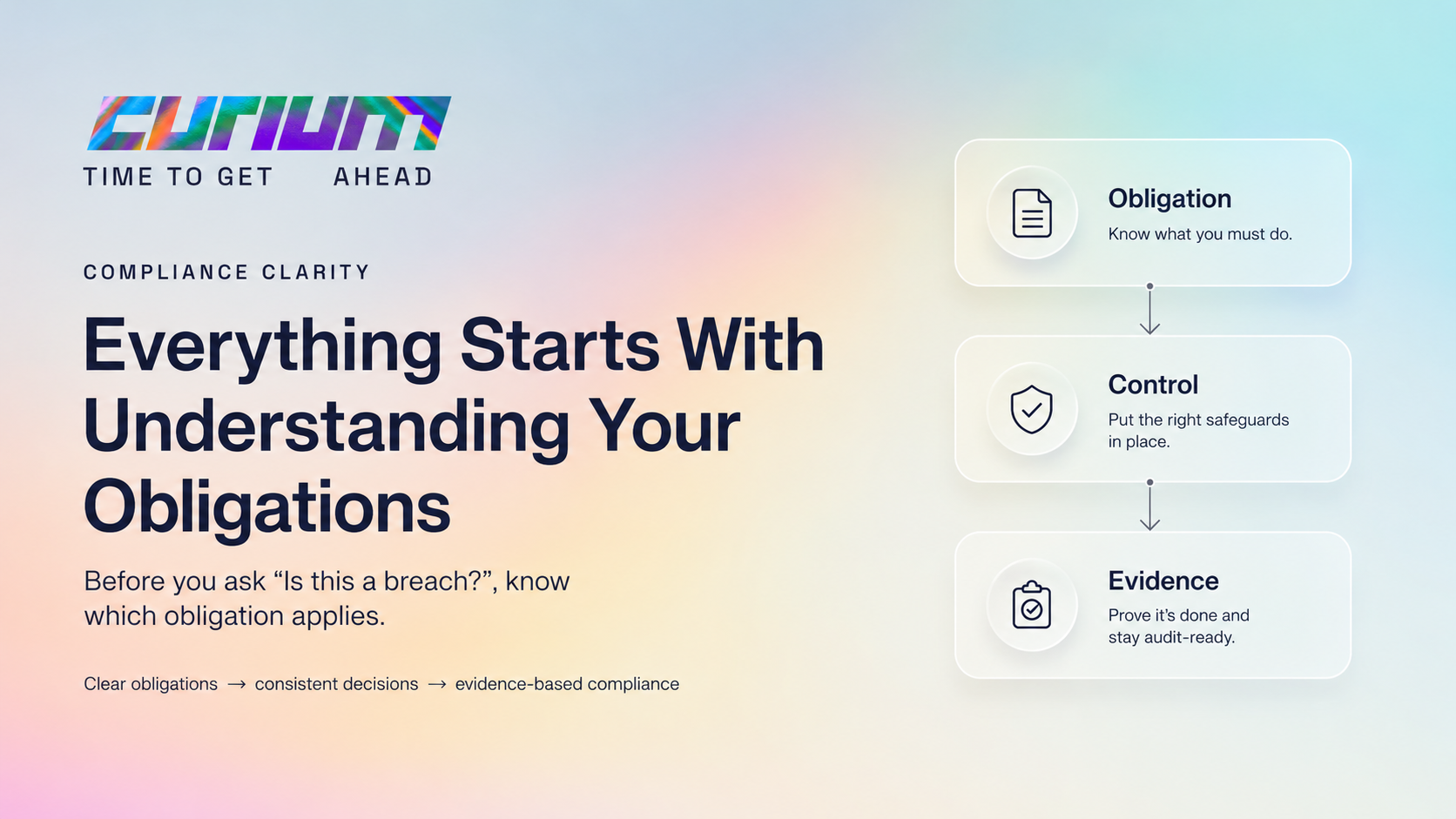
One of the most common questions we hear from compliance teams is:
“Is this a breach?”
It sounds like a simple question. But in reality, it is often the wrong place to start.
Before you can determine whether something is a breach, you need to understand what obligation may have been breached in the first place.
Yet this is where many organisations struggle.
Over the years, compliance frameworks have become increasingly complex. New regulations are introduced, industry codes evolve, regulators issue guidance, and businesses create internal policies on top of it all. The result is often a tangled web of requirements that very few people fully understand.
When obligations are unclear, compliance becomes guesswork.
Teams spend hours debating whether an incident is reportable. Managers have different interpretations of the same event. Similar situations are treated differently across business units. Decisions become subjective rather than consistent.
The problem is not usually a lack of effort.
The problem is a lack of clarity.
The Hidden Cost of Unclear Obligations

Most compliance failures do not happen because people deliberately ignore the rules.
They happen because people do not know exactly what the rules require.
Consider a simple customer complaint.
One person sees a service issue.
Another sees a potential breach of RG 271.
A third sees a training opportunity.
A fourth sees nothing at all.
The underlying event has not changed. The interpretation has.
This is why two organisations can experience the same issue and reach completely different conclusions about whether it represents a breach, a reportable situation, a conduct risk, or simply a process improvement opportunity.
Without clearly defined obligations, consistency is impossible.
See how Curium helps teams turn complex requirements into clearer obligations, so compliance decisions are based on evidence rather than interpretation.
Compliance Should Not Depend on Individual Interpretation
Good compliance frameworks remove ambiguity.
They break complex legislation, regulatory guides, codes of practice and internal policies into clear, actionable obligations that people can understand and apply.
Once obligations are defined, everything else becomes easier.
Controls can be mapped to specific requirements.
Monitoring can focus on measurable outcomes.
Incidents can be assessed consistently.
Breaches can be identified objectively.
Reporting becomes faster and more accurate.
Most importantly, decisions become repeatable.
The question shifts from:
“Do we think this is a breach?”
to:
“Which obligation applies, and was it met?”
That is a much easier question to answer.
When obligations are unclear, compliance decisions become harder to explain and harder to repeat.
See how Curium helps teams turn complex obligations into clearer, more consistent compliance decisions.
The Compliance Maturity Gap
Many organisations invest heavily in breach management, incident registers and reporting processes.
Far fewer invest in creating a structured obligations framework.
This creates a maturity gap.
Businesses become highly efficient at managing problems after they have occurred but struggle to identify risks before they become incidents.
In our experience, the organisations with the strongest compliance outcomes are not necessarily those with the largest compliance teams.
They are the organisations that have taken the time to define their obligations clearly and connect them to day-to-day business activities.
Their people understand what good looks like.
Their controls have a purpose.
Their monitoring has context.
And their compliance teams spend less time interpreting and more time improving.
See how Curium connects obligations to day-to-day business activities, helping teams identify risks earlier and improve compliance maturity over time.
Eliminating the Guesswork

The future of compliance is not about creating more policies, more registers or more reporting templates.
It is about creating clarity.
Every obligation should be documented, understood and connected to the business processes that deliver customer outcomes.
When that happens, compliance stops being a matter of opinion.
It becomes evidence-based.
The debate about whether something is a breach becomes significantly simpler because the organisation already knows what it was required to do.
And that is where effective compliance starts.
Not with breaches.
Not with incidents.
Not with reporting.
With understanding your obligations.
See how Curium helps organisations remove ambiguity from compliance decisions by linking obligations, evidence, controls and outcomes in one platform.
Author:
Tetiana George, CEO of Curium, Co-Chair of Insurtech Australia and member of ASIC Digital Finance Advisory Committee. LinkedIn Profile.