
ASIC’s latest Internal Dispute Resolution data for HY1 2025 in general insurance reveals something uncomfortable.
Not a spike in complaints.
Not a collapse in service.
Something more fundamental.
Most firms aren’t seeing complaints at all.
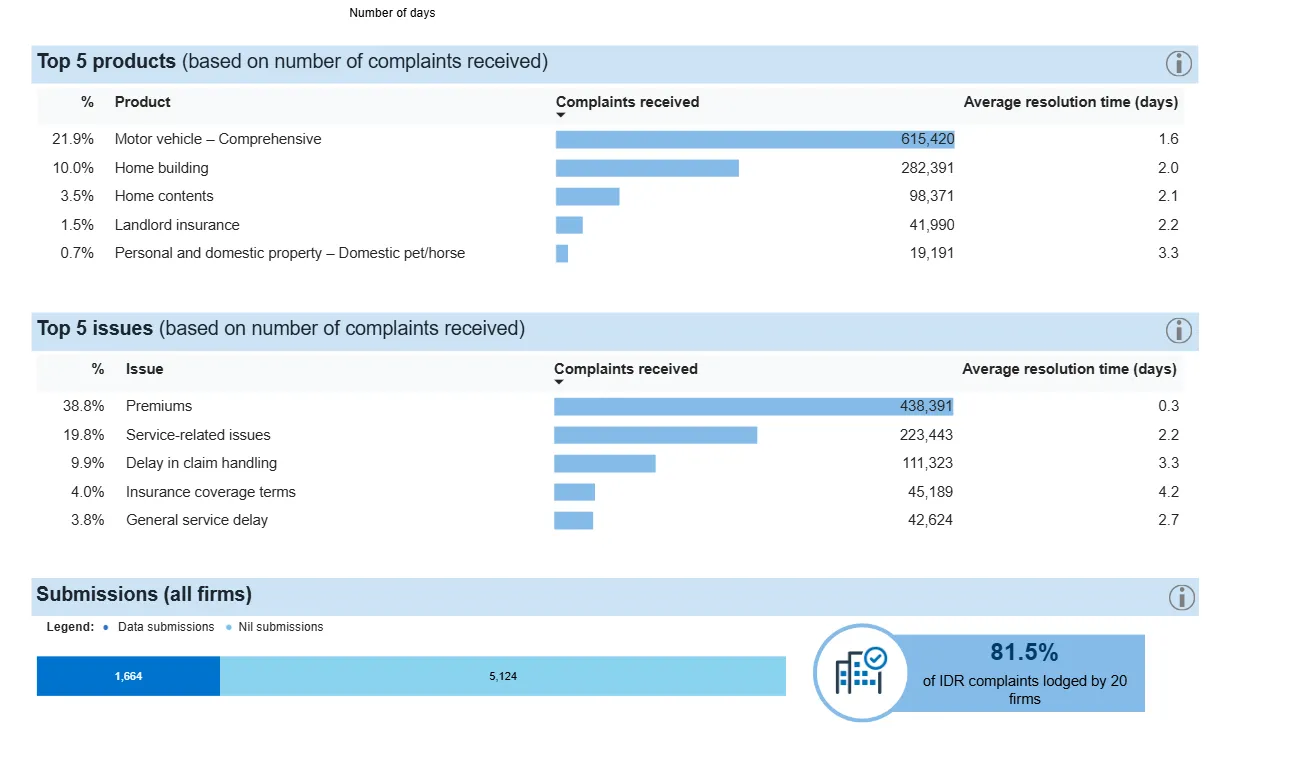
Around 75% of general insurance firms reported zero complaints, while the top 20 firms accounted for more than 80% of all complaints lodged.
At first glance, this looks like concentration — a handful of large players doing something wrong.
In reality, it points to something else entirely.
The idea that three quarters of the market has no complaints simply doesn’t hold up.
ASIC has been explicit under RG271:
A complaint is any expression of dissatisfaction.
Not just formal complaints.
Not just written ones.
Not just escalations.
A frustrated email.
A follow-up call asking why something is delayed.
A broker pushing back on an outcome.
These are all complaints.
So when firms report zero, it’s rarely because customers are perfectly satisfied. It’s because those signals are not being recognised, captured, or recorded.
The concentration at the top tells a different story.
Large insurers are not necessarily worse — they are more transparent.
They tend to have:
- better systems,
- clearer definitions,
- stronger training,
- and more disciplined logging practices.
They are closer to how ASIC actually defines reality.
Smaller firms, MGAs and broker networks often operate differently:
- issues are resolved informally,
- dissatisfaction is treated as “service” rather than “complaints”,
- and logging depends heavily on individual judgement.
The result is not fewer complaints — just fewer recorded ones.
What’s even more telling is the nature of the complaints that are captured.
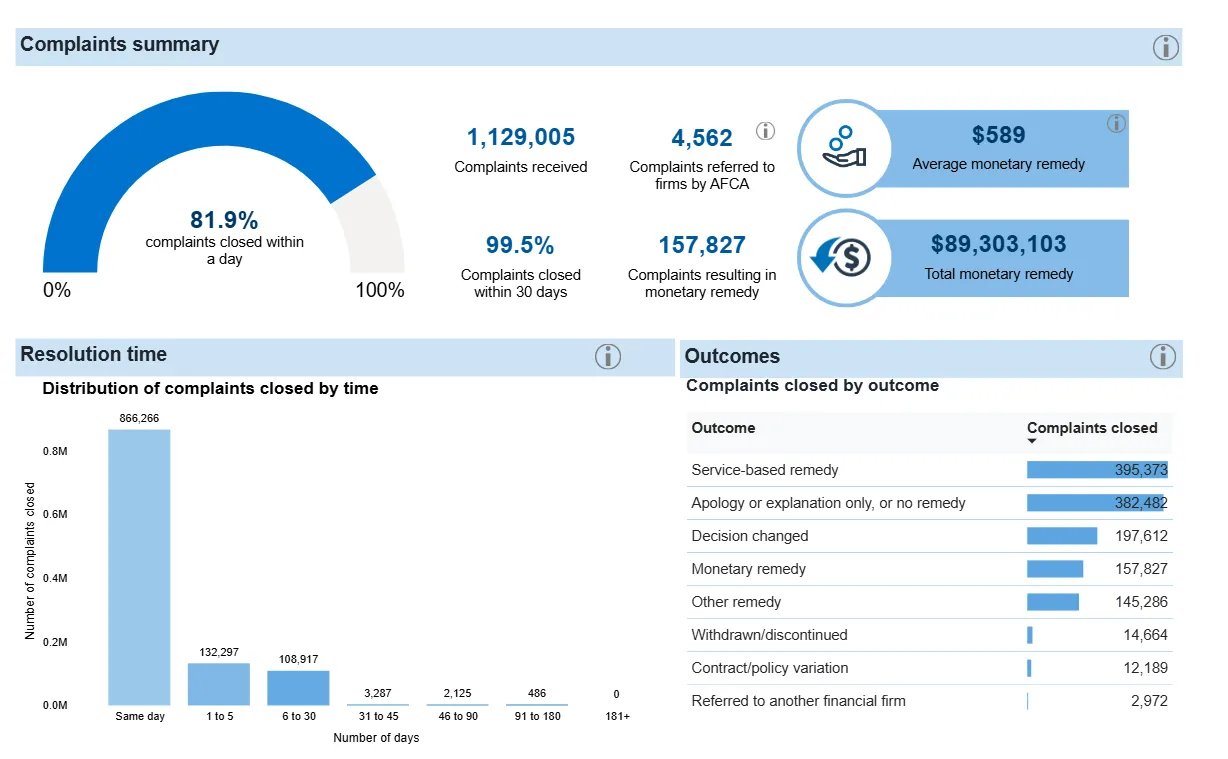
The majority are resolved quickly — more than 80% within a day.
Most do not involve a financial remedy.
They are fixed with:
- a clarification,
- a correction,
- a service adjustment,
- or simply an apology.
This changes the narrative entirely.
Complaints are not, in most cases, major disputes or failures.
They are early signals — small moments where expectations and delivery diverge.
Handled properly, they are low-cost, high-value opportunities to fix issues before they escalate.
Missed, they become something else:
- repeat incidents,
- systemic issues,
- AFCA complaints,
- reportable breaches.
This is why ASIC is increasingly using complaint data as a regulatory signal.
Complaints are no longer operational noise.
They are leading indicators of:
- claims handling quality
- product clarity
- communication breakdowns
- governance effectiveness
And importantly — whether a firm actually understands what is happening inside its own operations.
If complaint data is incomplete, everything that sits on top of it becomes unreliable:
- breach assessments,
- board reporting,
- regulatory submissions,
- risk decisions.
At its core, this is not a resolution problem.
It’s a detection problem.
Most firms are reasonably good at resolving complaints once they are formally logged.
But detection is still:
- manual,
- inconsistent,
- dependent on individuals,
- and often lost in email threads or conversations.
We see this play out repeatedly:
- a complaint sits with a supplier and is never passed on,
- an issue is resolved informally and never recorded,
- dissatisfaction only surfaces when it reaches AFCA.
By then, it’s already too late.
There is also a cultural layer to this.
A strong compliance environment relies on a simple principle:
See something, say something.
But in practice:
- staff avoid logging complaints because it feels like escalation,
- brokers fix issues quietly to maintain relationships,
- teams “manage things away” rather than formalise them.
The outcome is predictable:
Artificially low complaint volumes — and artificially high risk.
Curium’s view: the market is under-reporting, not over-performing
ASIC’s HY1 2025 data does not show a calm, well-functioning market.
It shows a visibility gap.
For insurers, MGAs and brokers, the implications are clear.
If you are reporting zero complaints, assume you are missing them.
Redefine complaints in practical terms — not legal ones. Train teams on what dissatisfaction actually looks like in day-to-day interactions.
Move detection upstream. Complaints should be identified in emails, calls, broker conversations and supplier interactions — not just when they hit formal IDR processes.
Treat complaint data as what it really is: a diagnostic tool, not just a reporting requirement.
And most importantly, reduce reliance on human judgement alone. The definition of “any dissatisfaction” is too broad — and too subjective — to be applied consistently without support.
Final thought
The firms reporting the most complaints are not necessarily the worst performers.
They are the ones who can actually see what is happening.
And in ASIC’s world, that is quickly becoming the difference between reactive compliance — and real control.